When to Shift Your Budget from PPC to SEO: A 2026 Hawaii Strategy
For businesses operating in the competitive Hawaiian market, Pay-Per-Click (PPC) advertising often provides an immediate and measurable influx of leads and sales. It's the swift current that gets your boat moving. But for CFOs, CEOs, and business owners focused on sustainable growth and optimizing shareholder value, the question isn't if to use PPC or SEO, but when and how to strategically transition between them.
The year 2026 looms, bringing with it evolving search algorithms, increasing ad costs, and a more sophisticated consumer. Understanding the strategic financial indicators for shifting your marketing budget from short-term PPC gains to long-term SEO dominance isn't just smart—it's essential for future-proofing your business in Hawaii.
This discussion moves beyond the simplistic SEO vs. PPC for financial advisors debate and applies to any business seeking high-value, long-term customer relationships. It’s about securing your digital future, not just winning today’s click.
PPC: The Short-Term Catalyst (And Its Inherent Limitations)
PPC, through platforms like Google Ads, offers instant visibility. You pay, you appear. This is invaluable for:
New Market Entry: Quickly generating awareness and traffic for a new product or service.
Promotional Spikes: Driving immediate sales for seasonal offers or urgent campaigns.
Targeted Lead Generation: Capturing highly specific, in-market demand.
In the Hawaii PPC landscape, this allows businesses to quickly test market appetite and gain initial traction. However, the "pay-to-play" model has inherent limitations for sustainable growth:
Cost Escalation: As competition intensifies, Cost Per Click (CPC) naturally rises. This can erode profit margins, as discussed in industry reports on ad spend trends.
No Long-Term Asset: Your visibility disappears the moment your budget runs out. You're renting traffic, not owning it.
Limited Trust Building: While effective for direct response, PPC often lacks the long-term credibility and authority building that organic search provides.
For sophisticated businesses, the goal is to leverage PPC to validate demand, then strategically pivot to a channel that builds an appreciating asset: SEO.
The Tipping Point: When to Begin Your Strategic Pivot
Deciding when to shift resources isn't arbitrary; it's data-driven. Look for these key indicators:
1. Diminishing Returns on PPC Spend
Rising CPC & Flat Conversion Rates: Your cost per click is increasing, but your conversion rate or customer acquisition cost (CAC) isn't improving, or is even worsening.
Maximum Scalability Reached: You've saturated your target PPC audience, and adding more budget doesn't significantly increase conversions, only inflate costs.
Lower Ad Position Effectiveness: You're spending more to maintain top ad positions, but the difference in conversion between position 1 and position 3 is negligible, or even declining.
2. Strong Organic Foundations Emerging
Improving Core Web Vitals: Your website speed, interactivity, and visual stability are meeting Google's official benchmarks.
High-Quality Content Accumulation: You've consistently published valuable content that naturally addresses user queries and builds authority.
Positive User Engagement Metrics: Organic traffic shows longer time-on-page, lower bounce rates, and higher engagement than PPC.
3. Strategic Business Goals for Long-Term Value
Building Brand Equity: The business prioritizes long-term brand authority and thought leadership over immediate transactional gains. This is especially true for industries like financial advisors, where trust and credibility are paramount and earned over time.
Reducing CAC: A desire to lower the long-term Cost of Customer Acquisition (CAC), as SEO leads typically have a lower CAC than PPC leads over time.
Increased Market Share: Aiming to capture a larger, more stable share of organic search visibility, which translates to a more resilient market position.
Measuring the ROI of Your SEO Investment
A key driver for this strategic shift is understanding the financial power of SEO. Unlike PPC, where ROI is immediate and transactional, SEO ROI is a compounding asset.
The value of SEO comes from two primary sources:
Traffic and Conversions: By ranking for high-intent keywords, you drive a steady stream of qualified leads and sales without paying for every click. You can calculate a direct ROI:
((Value of Organic Conversions - Cost of SEO) / Cost of SEO) x 100.Brand Equity & Asset Value: Your content library (blogs, guides, videos) becomes a digital asset. Its value grows over time as it continues to attract traffic, build authority, and generate leads long after the initial investment. This sustained presence significantly increases your Customer Lifetime Value (CLV) from organic channels, a concept detailed in publications like Forbes.
While the initial investment in a robust content strategy and technical SEO can be significant, the long-term returns consistently outperform the rental model of PPC for sustainable growth.
The Strategic Budget Phasing Model
The transition from PPC to SEO isn't an overnight flip of a switch. It’s a gradual, data-driven reallocation of resources. Here’s a visual model of how a business might phase its budget over time:
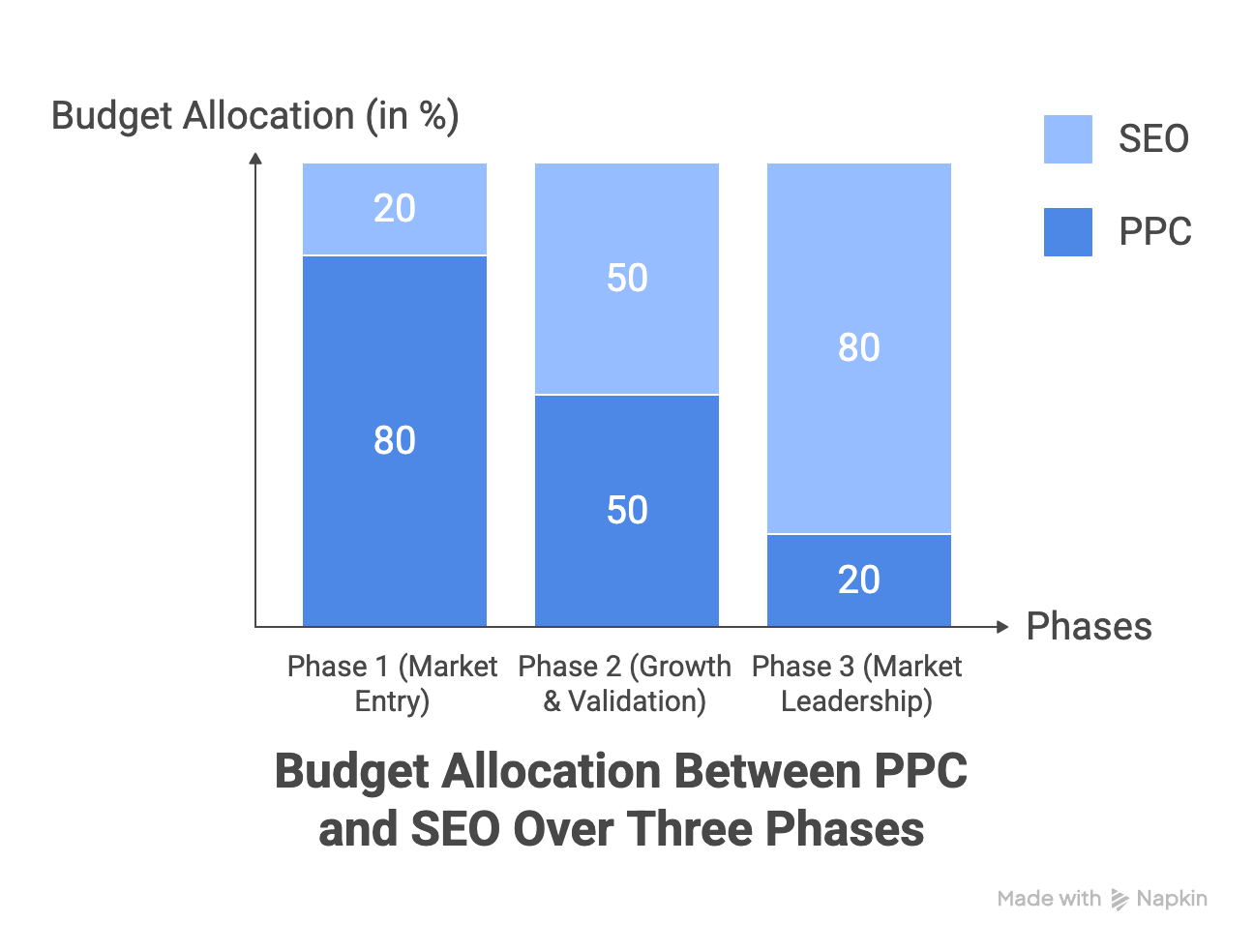
This model allows your business to maintain short-term lead flow with PPC while strategically investing in the long-term, high-ROI engine of SEO.
Is Your Business Ready for the SEO Pivot? A Checklist
Use this checklist to evaluate if now is the right time to begin your strategic budget shift.
[ ] Our Cost Per Click (CPC) has been steadily rising for the last 6 months.
[ ] We have a clear understanding of our top-performing organic keywords.
[ ] Our website has strong technical foundations (e.g., fast load speed as per Google's Core Web Vitals).
[ ] We have a process for consistently creating high-quality content.
[ ] Our business goals prioritize long-term, sustainable growth over short-term spikes.
[ ] We have a method for tracking organic conversions and user engagement.
If you checked three or more of these boxes, it’s time to seriously consider a strategic budget reallocation with a Holistic Marketing Budget Analysis.
Case Study: A Financial Advisor's Strategic Pivot in Honolulu
Let's consider a practical example: "Aloha Wealth Management," a fictional, high-value financial advisory firm in Honolulu. Their journey illustrates the sophisticated SEO vs. PPC for financial advisors debate perfectly.
Phase 1: Initial Growth with PPC
When Aloha Wealth Management first launched, they needed to attract their initial high-net-worth clients quickly. Their strategy was to use Hawaii PPC to target very specific, high-intent keywords like "Honolulu retirement planner" and "investment advisor Hawaii."
This approach worked. It generated immediate leads and helped them build their initial client base. However, they soon faced two significant challenges:
Exorbitant Costs: The Cost Per Click (CPC) for these valuable keywords was incredibly high and constantly rising due to fierce competition.
No Lasting Value: The moment they paused a campaign, their lead flow stopped completely. They were renting visibility, not building a lasting asset.
Phase 2: The Strategic Shift to SEO
Recognizing the limitations of a PPC-only model, the firm's leadership made a strategic decision to begin reallocating their budget toward a robust, long-term SEO strategy. Their goal shifted from buying leads to earning trust and authority.
Their SEO efforts focused on:
Authoritative Content: They launched a blog featuring in-depth articles answering the core questions of their ideal clients, such as "Navigating Hawaii's Estate Tax Laws," "Investment Strategies for Kamaʻāina," and "How to Build a Multi-Generational Legacy."
Building Trust: Their goal was to become the #1 organic result for broader, trust-building search terms like "best financial advisors Honolulu." This ranking is an invaluable, long-term digital asset that can't be bought overnight.
Local SEO: They optimized their Google Business Profile, encouraging reviews from satisfied clients to dominate local "near me" searches.
By making this pivot, Aloha Wealth Management transitioned from a costly, short-term lead generation tactic to building a sustainable, authoritative brand that attracts a steady stream of highly qualified, inbound leads. They lowered their long-term Customer Acquisition Cost (CAC) and solidified their position as a market leader.
Future-Proof Your Hawaii Business with JB Brands
In 2026 and beyond, businesses that master the strategic balance between PPC and SEO will be best positioned for sustained growth in the Hawaiian market. This isn't just about clicks; it's about building enduring digital assets that deliver compounding returns.
Don't let rising ad costs dictate your future. JB Brands specializes in providing a Holistic Marketing Budget Analysis designed to optimize your ad spend for both short-term wins and long-term organic growth. We help CFOs, CEOs, and business owners in Hawaii define their strategic tipping point and execute a seamless, profitable transition.
Let's partner to ensure your marketing budget works smarter, not just harder, for your Hawaiian success.